
This is a summary of a lecture delivered at the launch of Mallam Musa Abdulhameed Atanda’s book titled “Voluntary Fasting in Islam” on 4TH December 2022 (10th Jumada al-Awwal, 1444) on Zoom.
Conceptualising Ibadah
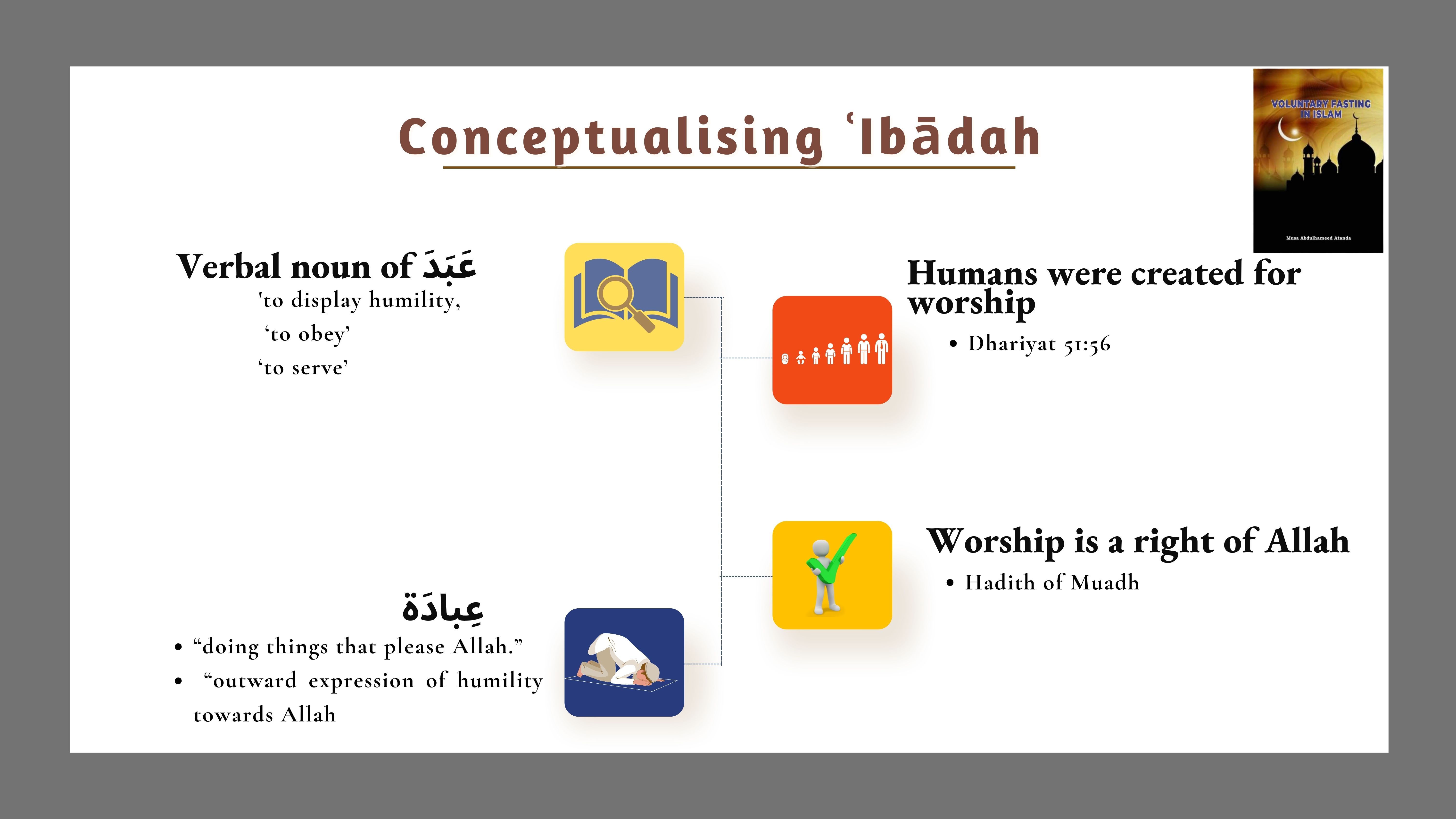
Ibadah, translated as worship in English, has been defined in various forms in Islamic literature. Before looking at one or two of these definitions, it will be beneficial to mention that the word ibadah is a verbal noun of the Arabic verb “عَبَدَ” which means ‘to be submissive’, ‘to display humility’, ‘to obey’ and ‘to serve’. Technically, ibadah means “doing things that please Allah” or “outward expression of humility towards Allah.” The Arabic equivalent of the word slave (عَبْدٌ)is derived from this verb too.
Although ibadah is not solely a human phenomenon, various creatures of Allah engage in distinct forms of ibadah, which we humans may not comprehend. Yet the verse of the Qur’an, “And I did not create the jinn and mankind except to worship Me”,[1] makes us understand the loftiness of ibadah. We can infer that as humans, our eating, drinking, playing, working, and studying are all secondary to our worshipping Allah. The Prophet, Allah, in a hadith that captures dialogue with Muadh ibn Jabal, has also made us understand that ibadah is a right Allah has over us!
The Prophet (ﷺ) said, “O Mu`adh! Do you know what Allah’s Right upon His slaves is?” I said, “Allah and His Apostle know best.” The Prophet (ﷺ) said, “To worship Him (Allah) Alone and to join none in worship with Him (Allah). Do you know what their right upon Him is?” I replied, “Allah and His Apostle know best.” The Prophet (ﷺ) said, “Not to punish them (if they do so).[2]
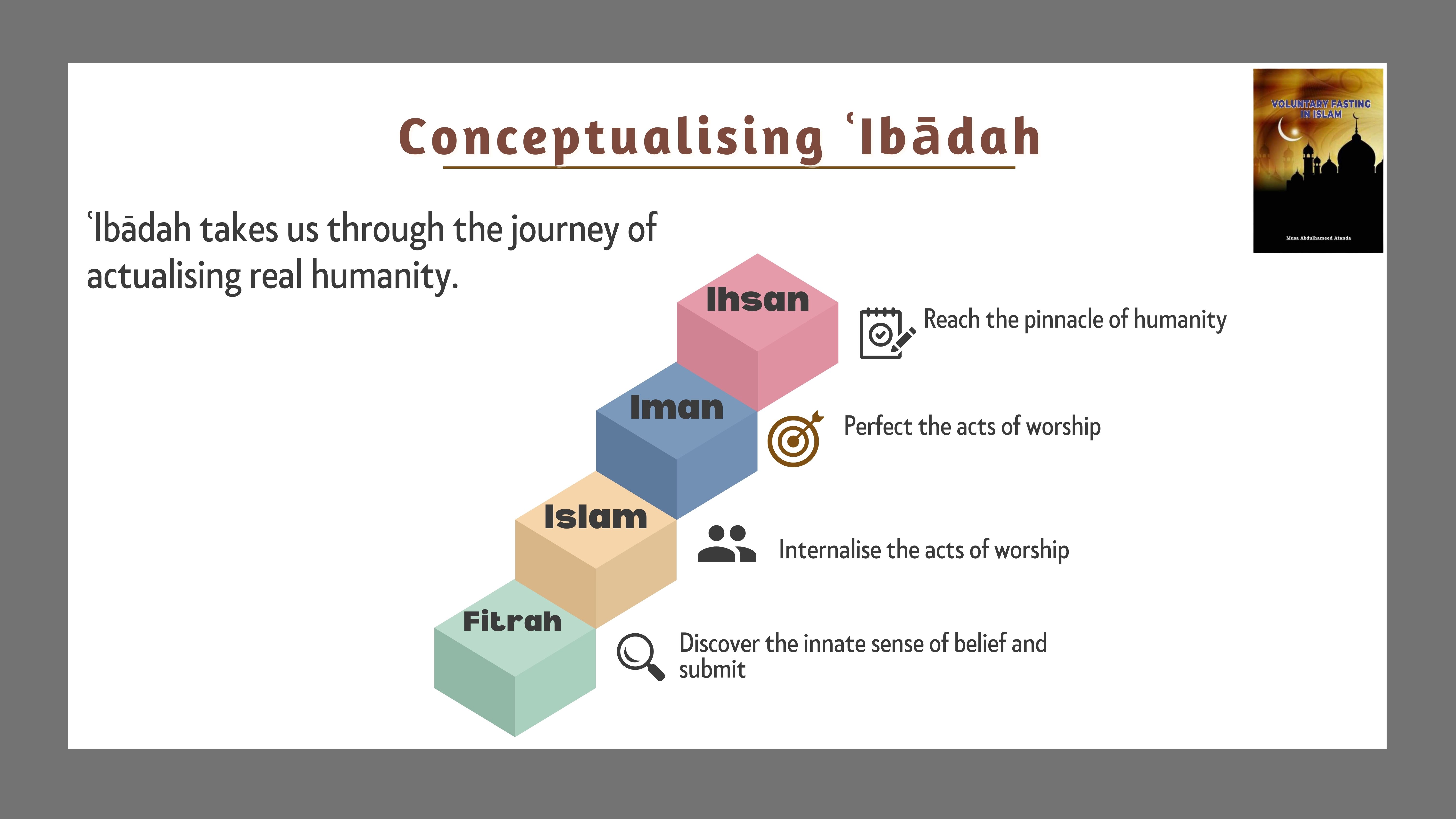
Ibadah can also be appreciated better in that just as the belief in Allah is an innate feeling embedded in our fitrah[3] as humans, ibadah, when performed well, leads us to the pinnacle of being humanity- the status of Ihsan. This is as expressed in Hadith of Jubril. “Ihsan is to worship Allah as if you see Him, and if you do not see Him, He Allah sees you.”[4] We become Muslims by manifesting and accepting the faith already in our fitrah. Then we submit to it and observe the ibadah as required by the submission. We move to the next stage of the ladder when we internalise these acts of ibadah. The perfection of these makes one Muhsin the highest human status.
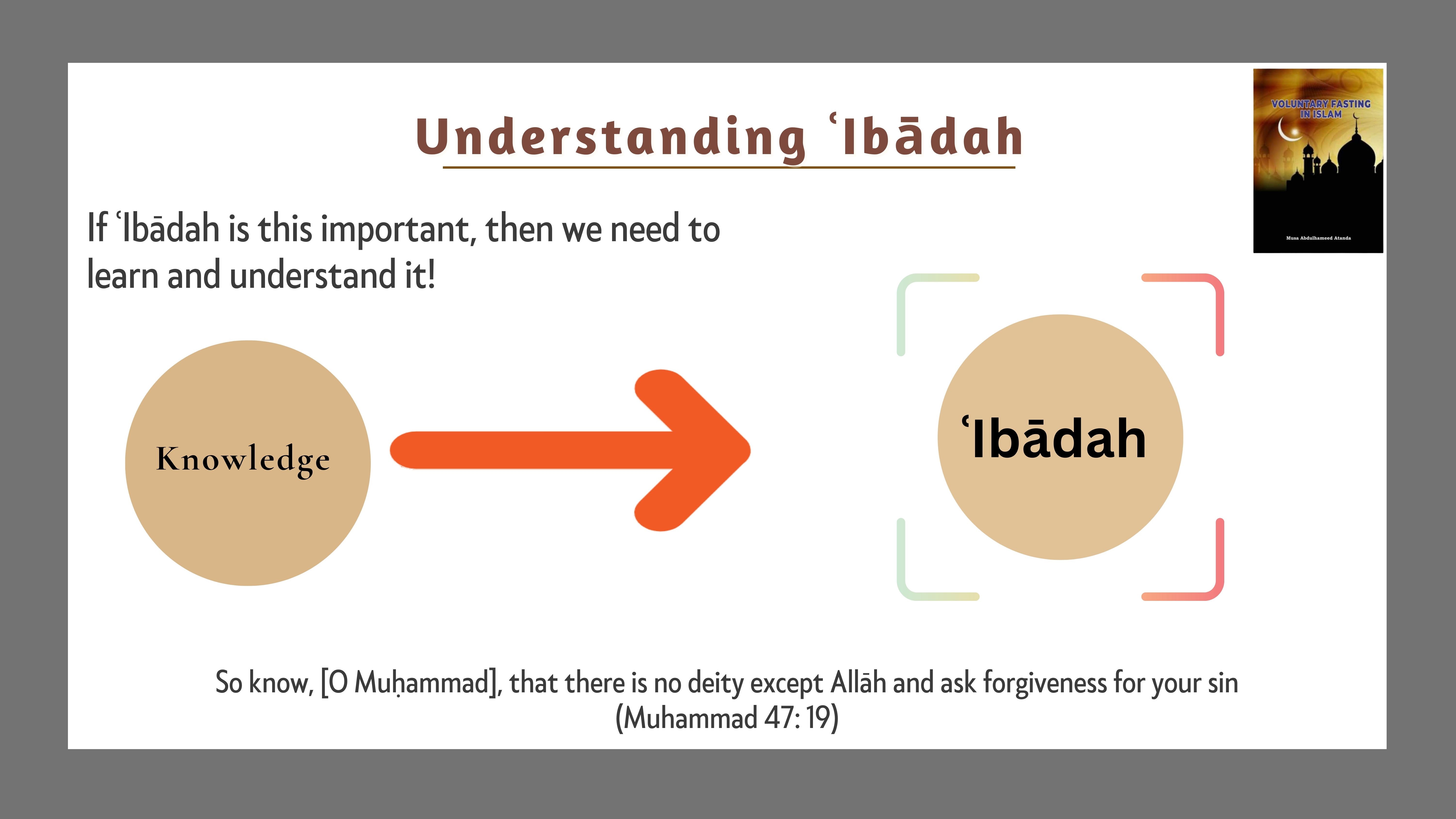
If ibadah is as crucial as this, what should our attitude be? The answer any sane person will give to this is that we should take care of it. However, how do we take care of our ibadah if we do not learn it? This is of utmost importance because for an action to be accepted as ibadah, it should be deemed by Allah or His messenger as ibadah. And how do we know that if not for knowledge? In fact, Imam Bukhari has used the verse “So know, [O Muḥammad], that there is no deity except Allāh and ask forgiveness for your sin”[5] as evidence that knowledge precedes speech and action.
Knowledge of Ibadah
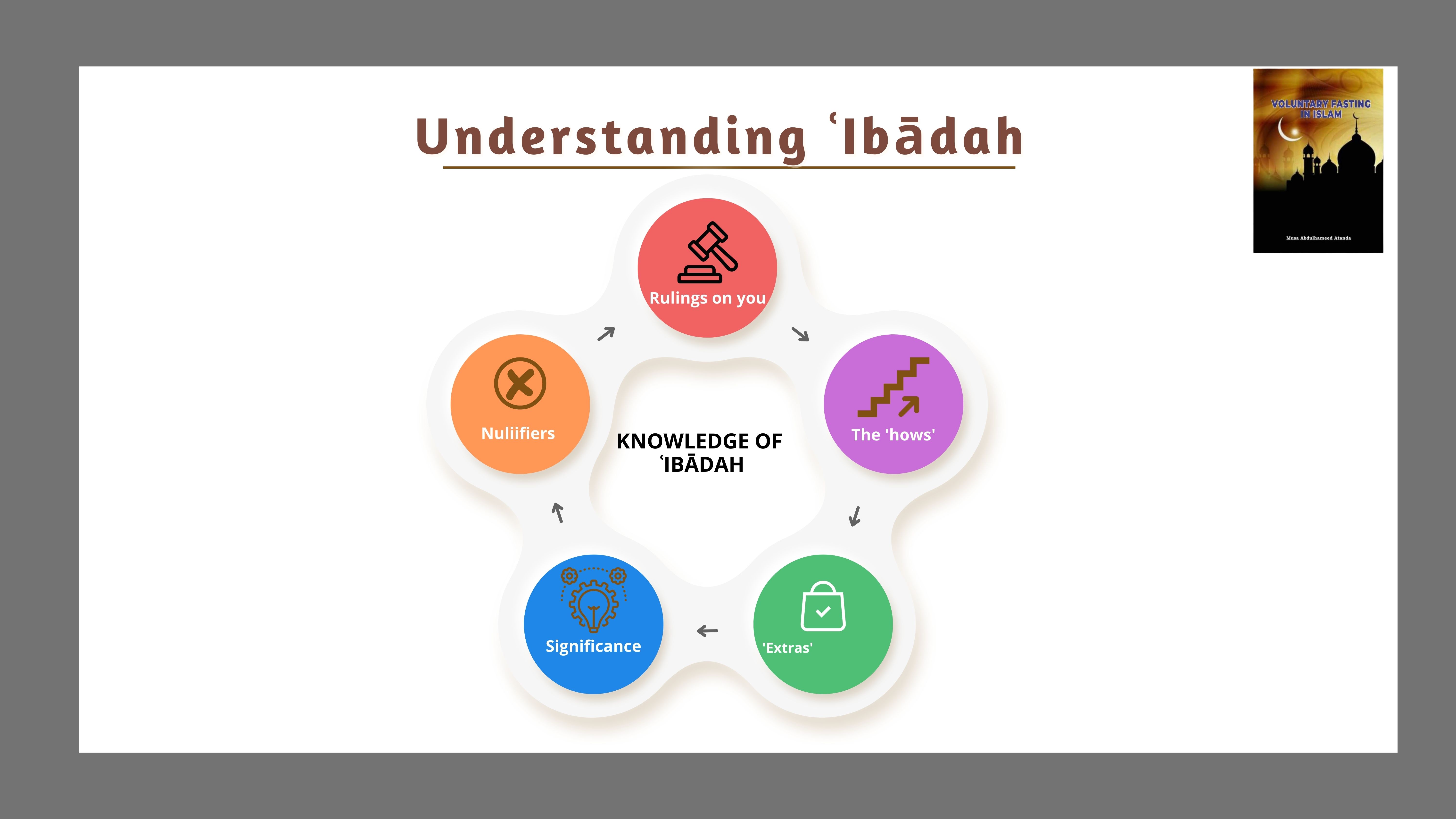
After we have understood the significance of ibadah and made a case for the necessity of learning it, it is essential to mention that the scope of ibadah is defined based on the hadith “Whoever innovates something in this matter of ours (i.e. Islam) that is not part of it, will have it rejected.”. Thus, we may deduce from this that the sources of knowledge of the ibadah, an integral part of Islam, are defined too- the Qur’an and Sunnah. These two sources tell us what Allah wants us to do and how He wants us to do it. Based on these sources, we have scholars, the inheritors of the Prophet, who have taken their time to draw up various rulings as contained in these sources. Now, we can pick up books or digital materials on salah, for instance, which tells us what the salah is, what its ruling is, which one is compulsory, and which one is not, what nullifies it and what does not etc. Alhamdulillah, things are pretty easy today. There are materials in various languages and very handy. It is left for us to assess them to properly fulfil that daily covenant of “It is You we worship and You we ask for help.”[6]
Consequences of not learning about the ibadah
Firstly, it is important to know that the knowledge of ibadah covers knowing the essence of it, its rulings, as well as its significance. Since the purpose of our creation is ibadah, when not carried out or incorrectly performed, there are expected consequences. The consequences of not learning about ibadah are immediately seen in the emergence of heresies and innovations. Just as it can lead to the ultimate regret of being punished by Allah, not learning about ibadah can cause dissonances and calamities in both social and personal lives.
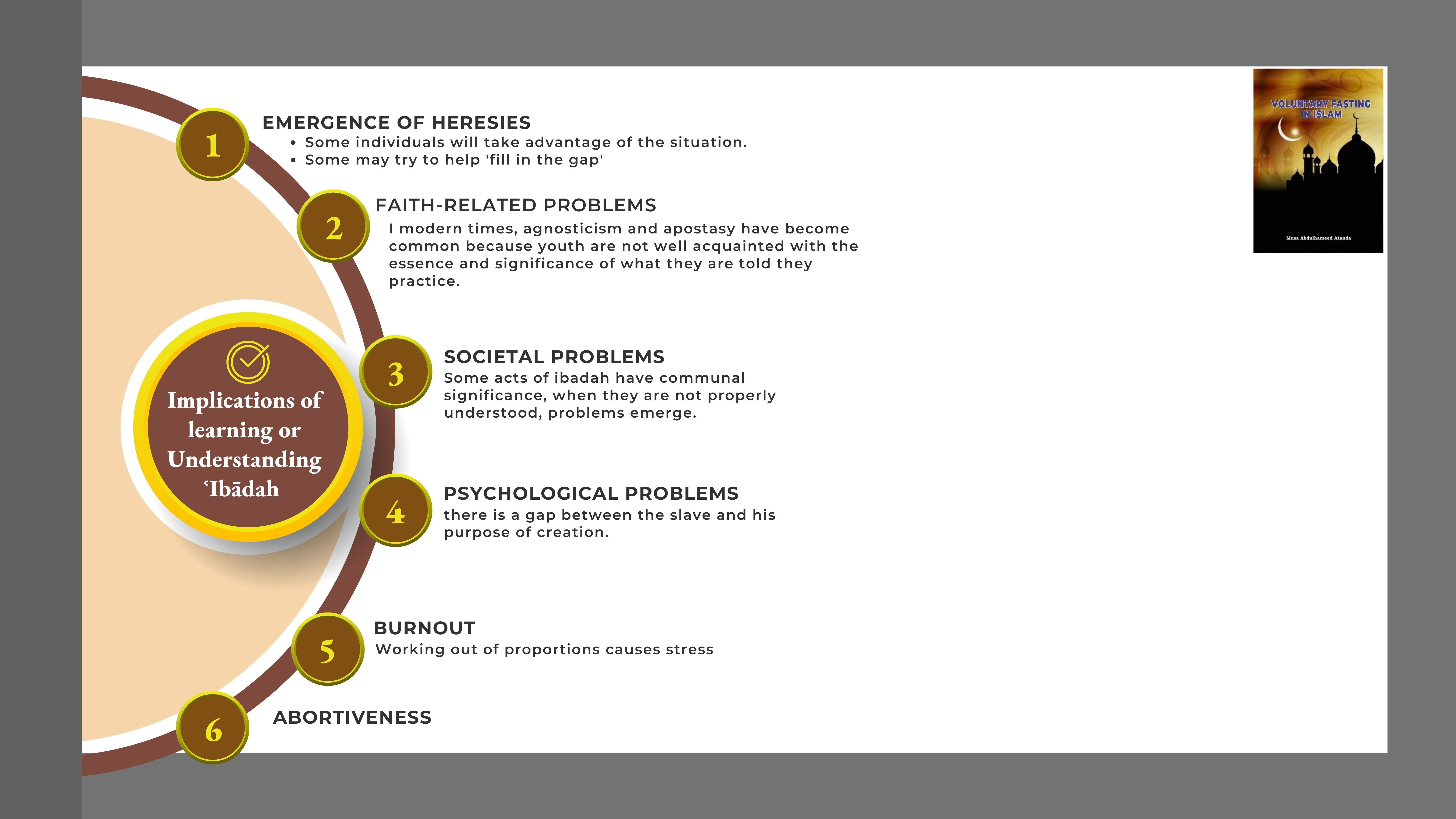
Heresy: when people do not learn about the ibadah commanded by Allah and His Prophet, some other people may take advantage of them and make them undergo certain unorthodox rituals in the deen. Meanwhile, why the formulation of innovations can be due to an innocent will to “fill in the gaps”; they are still, as the hadith said, misguidance.
Agnosticism/apostasy: Today, we live in a time when many young people have problems with their faiths. It is reasonable to assume that many of these youngsters are either not introduced to the worship of Allah or they are worshippers who never understood why or who they worship. If these individuals have been taught the essence and the significance of ibadah, they may have their faith held firmly.
Societal problems: many acts of ibadah, like zakah, sadaqah, and congregational salah, have their communal benefits. When these ibadah is missing due to ignorance or they are not done the way they ought to be, the community will miss out on the benefits.
Psychological problems: as earlier stated, the acts of ibadah are phenomena connected to the purpose of human creation and their total development. Thus, when they are missing or not correctly done, there is a tendency for the human to feel like a fish outside water, or a freshwater fish in salty water, as the case may be. In fact, some traditional Islamic psychologists opine that some psychological illnesses manifest the distance between a slave and His purpose of creation.
Burnout: just as ignorance causes errors of omission regarding ibadah, it can also cause errors of commission. When individuals are not acquainted with the ease and restrictions of ibadah, they stress themselves, thinking they are pleasing Allah. For instance, someone who does not know the ruling of qasr (shortening of prayer) will cause himself harm when he is on a long and tedious journey.
Abortiveness: when ibadah are not correctly learnt and performed, they automatically become fruitless. Such that instead of earning the blessings of Allah, one earns the punishment of Allah. May Allah save us from this!
How to learn about İbadah
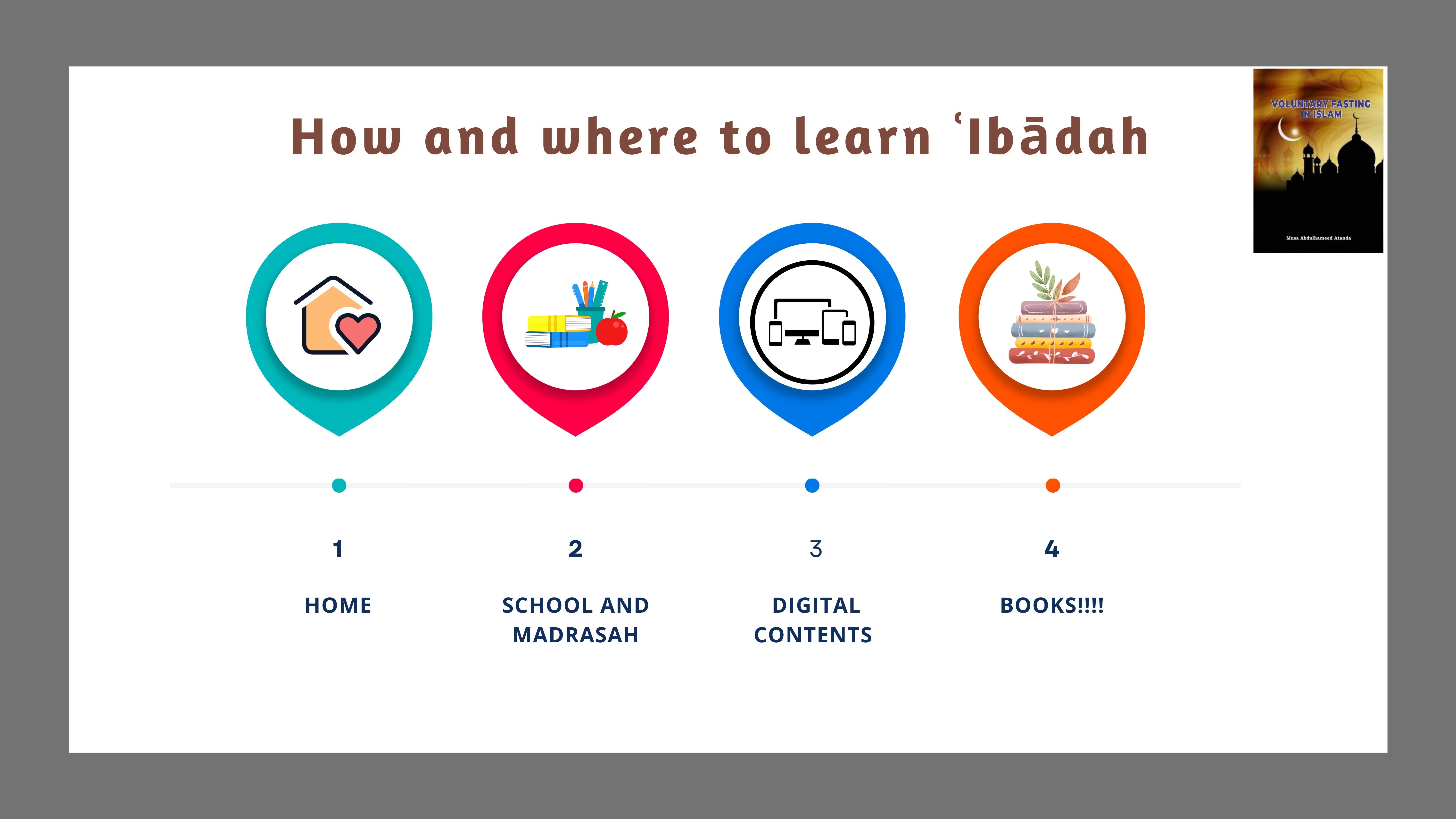
We have mentioned that ibadah is important and learning it is equally important. Since everything is not learnt everywhere, there may be avenues to learn the rulings of ibadah too. The world has changed so far that these avenues have come in handy, Alhamdulillah!
The most important place to learn the ibadah is our homes. Parents should teach their children to observe salah, fast, perform ablution, make dua etc. After that, parents should be keen to send their children to madrasahs and Islamic schools to learn about the deen. Here, the administration and the teachers should understand that performing the ibadah is essential and should take an important place in their curriculum.
Nonetheless, books and digital materials from reliable scholars are valuable resources that can help us learn about our worship, which is valid for adults and children. However, I will admit that books offer more options for further reference. That’s why it’s essential to have books and home libraries. Our scholars and intellectuals should write books, and publication should be made simpler for these works. Moreover, as a community, we should develop a reading culture.
That being said, we are here today to launch a book on The Voluntary Fast written by our esteemed brother, Mallam Abdulhamid Musa. May Allah accept the effort as an act of ibadah, and may it benefit me, you, and every other person who reads it. Amin!
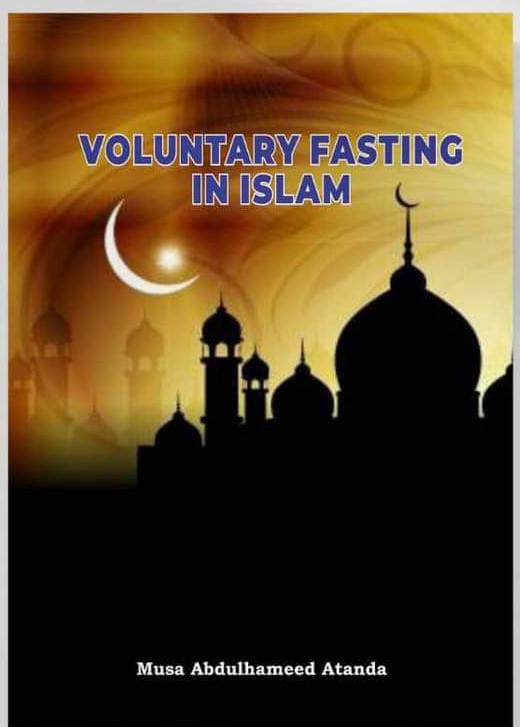
Mallam Musa AbdulHameed Atanda’s book.
For primary and secondary school students who have purchased this book, you can take a quiz on it. If you get a perfect score of 100 % you will be given a prize. Click here to attempt the quiz. This quiz is valid until January 20th 2023.
[1] Dhariyat 51:56
[2] Sahih al-Bukhari 7373. For proper reference, kindly check: https://sunnah.com/bukhari:7373
[3] Check Rum 30: 30.
[4] Sahih al-Bukhari 4777: For proper reference, kindly check: https://sunnah.com/bukhari:4777
[5] Muhammad 47: 19
[6] Fatiha 1:5
 Ifeoluwa Siddiq Oyelami