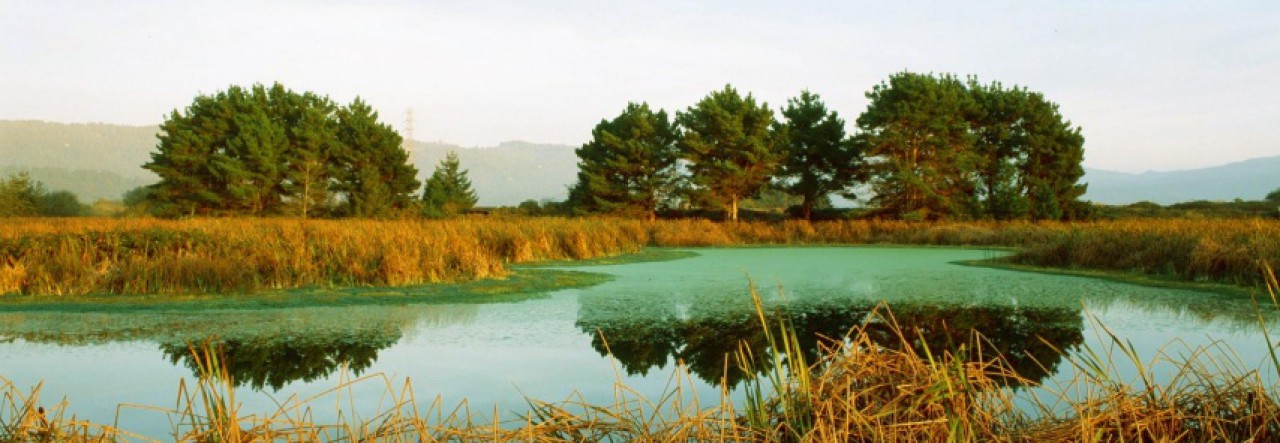
I had two favourite teachers in primary school. One was Mr. Olalekan, my literature teacher. He was my class teacher and the person who prepared me for my first public speech—“It is a popular saying that…” I was only nine.
The other was Mr. Adejumo, my social studies teacher. He instilled in me a deep curiosity for history…, and here we are today! However, Mr. Adejumo also taught me something wrong, and I am pretty sure your social studies teachers did too.
He said Nigeria was named by Flora Shaw and that the name was derived from “Niger Area”.
Unfortunately, both assertions are incorrect.
I have seen many content creators trying to romanticise this story… Nigeria was born out of a love affair between Flora Shaw and Frederick Lugard, the notorious first Governor-General of Nigeria. Well, keep the romance for YouTube and TikTok. History tells a different story.
To begin with, Flora Shaw, a British journalist and later the wife of Frederick Lugard, is said to have first used the term “Nigeria” in an article published in The Times on 8 January 1897. The name is often claimed to have been derived from “Niger Area”, meaning the region around the River Niger. Honestly, I do not know where this explanation comes from.
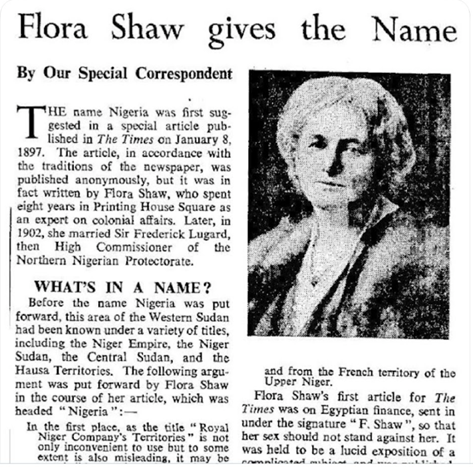
The common reference…. I don’t know the source
The narrative raises both historical and linguistic problems.
From a linguistic perspective, deriving Nigeria from “Niger Area” is awkward and does not conform neatly to established morphological patterns in European toponymy. A far more plausible explanation is that Nigeria emerged through the application of the Greek-derived territorial suffix -ia (-ία), commonly used in classical geographical naming conventions in the English language, as seen in Arabia, Persia, and Somalia. Under this logic, the land associated with the River Niger would naturally be rendered as Niger-ia.
Comparable mechanisms exist across languages: Persian uses -stan (Pakistan, Afghanistan), Turkic languages use -eli (Rumeli, Kocaeli), and Arabic employs the suffix -iyyā (Almāniyya).
Seen this way, Nigeria as Niger-ia makes perfect sense. Perhaps proponents of the “Niger Area” theory were merely trying, albeit unsuccessfully, to explain the meaning of the -ia suffix. We may never know.
So, was Flora Shaw the first person to use the name Nigeria? No.
She was born in 1852, yet the term appears in 1862. In that year, a travel journal by William Cole, a British trader who explored the region, referred to the inhabitants of the area as Nigerians. The book was titled Life in the Niger: Journal of an African Trader.
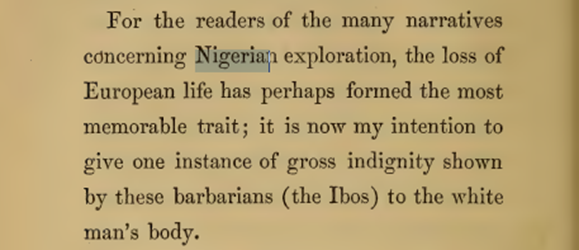
William Cole’s book (P. 34)
And for those who might argue that the name comes from “nigger,” the title of the book clearly shows “Niger” referring to a territory, not a people. Had it been a people, we would expect constructions such as “Niger Country” or “Niger Land”, similar to missionary-era terms like “Hausaland” or “Yoruba Country.”
So, back to the point.
Nigeria is not derived from “Niger Area”, and Flora Shaw did not name it. Your social studies teacher did not know, but your children’s teachers should not repeat the same error.
This, however, does not erase Shaw’s historical significance altogether. Rather than inventing the name, her role is better understood as one of institutional endorsement. By the time Nigeria was amalgamated in 1914, she was already married to the man in charge.
So yes…your love story may still hold some water… though it remains implausible.
 Ifeoluwa Siddiq Oyelami
I am humbled by this submission.
You just schooled me.
Education they say is learning, unlearning and relearning.
Khalidu A. AFOLABI
LikeLike